Kitchen appliances tend to promise more than they deliver. Anyone who has bought a gadget that claimed to replace five other tools, only to have it collect dust in a cabinet, understands the skepticism that comes with a product like a “multi-cooker.” So when a device specifically markets itself around solving the problem of timing a main dish and a side dish to finish at the same moment, it’s worth taking a closer look at what’s actually being offered, how it works, and whether the concept holds up to scrutiny.
The Instant Pot Dual Action 8-in-1 Multi-Cooker is built around a fairly specific idea: instead of juggling a rice cooker on the counter and a pressure cooker next to it, hoping both finish around dinnertime, this appliance combines a 4-quart pressure cooking chamber with a separate 2-quart rice cooking chamber in one unit. The headline feature, referred to as “Serve Together™ Smart Timing,” is designed to coordinate the finish times of both compartments so a main course and a side can land on the table together, rather than one going cold while the other finishes.
This article walks through what the appliance is designed to do, the features it includes, practical ways it might be used in a real kitchen, who might find it useful, and what to think about before deciding if it fits your cooking routine.
Key Features
Dual Cooking Chambers
The defining characteristic of this model is that it isn’t a single pot doing one job — it has two separate cooking compartments built into one housing. One side functions as a 4-quart pressure cooker, suitable for grains, stews, meats, and dishes that benefit from high-pressure, high-speed cooking. The other side is a 2-quart rice cooker chamber, intended for rice, grains, or smaller side dishes that don’t require pressure cooking at all.
This is different from many “multi-cookers” on the market, which typically offer multiple cooking functions but only one chamber, meaning you can pressure cook or sauté or slow cook, but only one function at a time, in one pot. Having two independent chambers means two different dishes, potentially with two different cooking methods, can be prepared simultaneously without one waiting on the other.
Smart Timing Coordination
The “Serve Together™” element refers to the timing logic built into the appliance. Because a pressure cooker and a rice cooker naturally operate on different cook times and methods (one relies on built-up pressure, the other on gentler steady heat), getting both to finish at the same time normally requires manual guesswork — starting one earlier, checking the other, adjusting as needed. This model is designed to calculate and coordinate the start and finish points of each chamber so that, ideally, the timer accounts for the different cook durations and brings both dishes to completion around the same time.
This is arguably the core value proposition of the product: not that it pressure cooks or rice cooks particularly differently than other machines, but that it removes some of the mental math and multitasking that typically comes with preparing a complete meal using multiple appliances.
Eight Cooking Functions
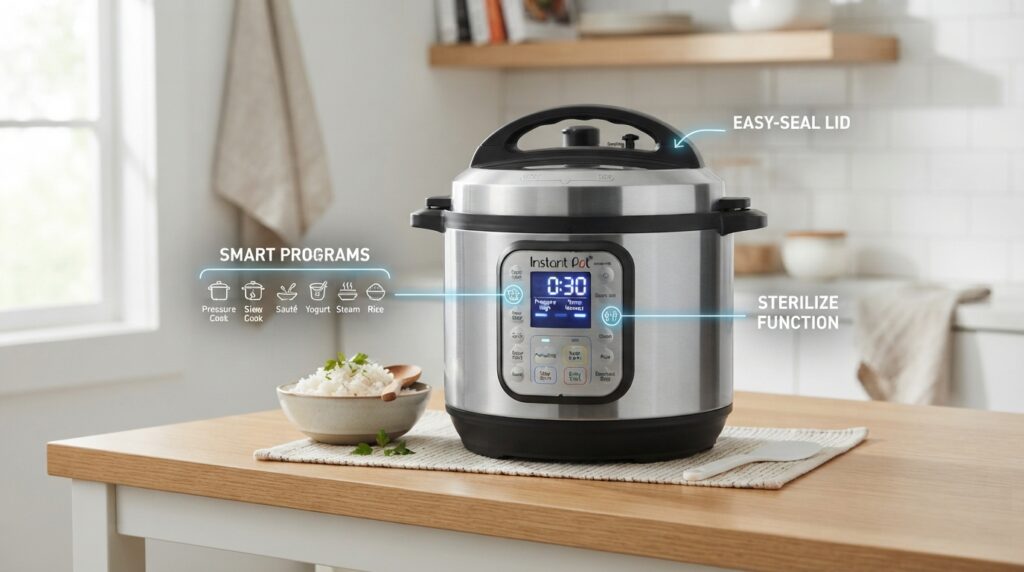
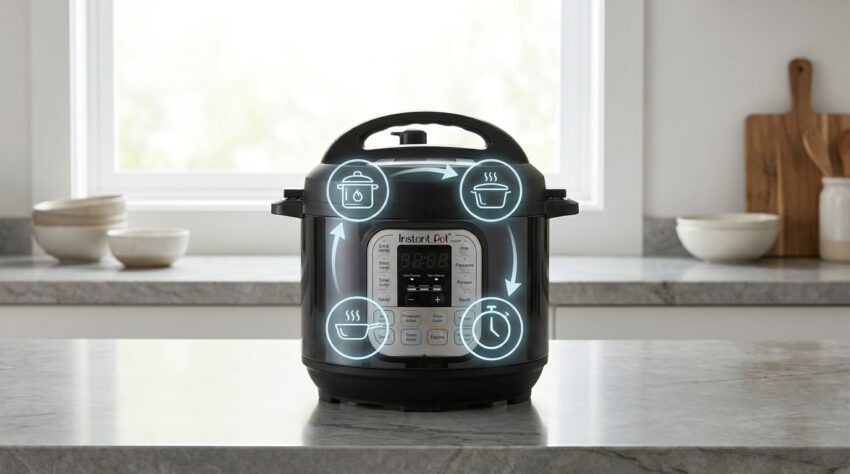
Beyond the two-chamber design, the unit is described as an 8-in-1 appliance, which generally refers to a range of cooking modes bundled into the pressure cooking side, such as:
- Pressure cooking
- Sautéing
- Slow cooking
- Rice cooking
- Steaming
- Warming
- Yogurt-making (in some Instant Pot configurations)
- Additional preset or manual cook settings
The exact list of functions can vary by specific model configuration, but the general idea is consistent with Instant Pot’s established design philosophy: consolidating multiple standalone appliances (rice cooker, slow cooker, steamer, sauté pan) into fewer countertop devices.
PFAS-Free Pot Construction
The product listing notes that the pot is PFAS-free. PFAS (per- and polyfluoroalkyl substances) are a group of synthetic chemicals historically used in some non-stick coatings, and there has been growing public and regulatory attention on reducing their presence in cookware due to environmental and health concerns. A PFAS-free inner pot is generally marketed as a feature for buyers who are specifically trying to avoid these compounds in items that come into direct contact with food. It’s worth noting that “PFAS-free” typically refers to the coating or pot material itself, and buyers who want more detail on the specific materials used may want to check the product’s specification sheet or manufacturer documentation directly.
Compact Footprint for Two Cooking Systems
Given that it houses two separate cooking compartments, the design is intended to keep the overall footprint reasonably manageable for a kitchen counter, rather than requiring the space of two full separate appliances side by side. This is a meaningful consideration for smaller kitchens where counter space is limited.
How It Can Be Used
The practical appeal of a dual-chamber cooker comes down to meal composition — most home-cooked dinners aren’t a single dish, but a main paired with at least one side. Here are some ways this type of appliance is generally used:
Protein and grain combinations. A common use case would be cooking a protein — chicken, beef stew, pulled pork, or beans — in the pressure cooking chamber while rice, quinoa, or another grain cooks in the second chamber. Since rice and many proteins have different ideal cook times, the coordinated timing feature is meant to prevent the classic problem of rice sitting warm (and drying out) for twenty minutes while a stew finishes.
Batch cooking for the week. Some users lean on multi-cookers for meal prep, cooking a larger batch of a main dish alongside a grain or starch that can be portioned into containers for the week ahead. Having two chambers can speed up this process since both components cook in parallel rather than sequentially.
Simplified weeknight dinners. For a straightforward weeknight meal — say, a curry with rice, or a braised dish with a side of steamed vegetables — this format is designed to reduce the number of steps and dishes involved compared to using a stovetop pot and a separate rice cooker.
Sauté-then-pressure-cook sequences. Many Instant Pot-style devices allow searing or sautéing ingredients directly in the pressure cooking pot before switching to pressure mode, which can reduce the need for a separate pan when building flavor at the start of a recipe.
Slow cooking on one side, warming on the other. Depending on functions available, one chamber might be used for a longer slow-cooked dish while the other handles a quicker side or keeps something warm until serving.
It’s worth noting that the two chambers are generally intended for different types of cooking — the smaller chamber is not a second pressure cooker, and understanding this distinction helps in planning what can realistically be cooked in each side.
Who It May Be Suitable For
Households cooking complete meals regularly. Because the standout feature is coordinating a main and a side, this device is likely most useful for people who regularly cook multi-component meals rather than single-pot dishes.
People consolidating kitchen appliances. For those trying to reduce the number of separate gadgets on their counter — a rice cooker, a slow cooker, a pressure cooker — a combined unit may help simplify storage and cleanup, provided it covers most of what those separate appliances were doing.
Busy families or meal preppers. Anyone trying to shorten the time between “start cooking” and “dinner is ready” may find value in a system built specifically to synchronize two dishes rather than manage them separately.
Smaller households mindful of counter space. Combining two appliances into one housing can be appealing for apartments, dorms, or kitchens where space is at a premium.
Buyers interested in PFAS-free cookware. Those specifically shopping with non-stick chemical exposure in mind may see the PFAS-free pot as a relevant feature, though it’s reasonable to also compare this against other cookware options that make similar claims.
On the other hand, someone who typically cooks single-dish meals, or who rarely needs rice or a side prepared simultaneously with a main, may not get as much practical use out of the dual-chamber design specifically, even if the other cooking functions remain useful on their own.
Important Things to Consider
Capacity limits per chamber. With a 4-quart pressure cooking side and a 2-quart rice cooking side, this unit is generally sized for smaller households or moderate portions rather than large family batches. Those regularly cooking for a large group may want to check whether these capacities align with typical serving sizes before assuming it will handle bigger meals.
Learning curve for timing features. As with most electric pressure cookers, there is typically a learning period involved in understanding cook times, pressure release methods, and how the smart timing feature behaves with different recipe combinations. Reading the included manual and getting familiar with recommended settings for various food types is generally advisable before relying on any automatic coordination feature for a big meal.
Cleaning and maintenance. Having two chambers means two areas to clean rather than one. It’s worth considering how the inner pots, lids, and sealing components are designed for cleaning, and whether parts are dishwasher-safe, since this affects daily convenience.
Countertop storage. While more compact than two separate appliances, a dual-chamber unit is still generally larger than a single multi-cooker. Measuring available counter or storage space beforehand can help avoid surprises.
Not a replacement for every cooking method. Pressure cooking and rice cooking cover a wide range of dishes, but they don’t replace baking, grilling, or high-heat searing in the way a stovetop or oven does. It’s reasonable to view this as a strong tool for a specific category of meals rather than an all-purpose kitchen replacement.
Warranty and support documentation. As with any electric kitchen appliance, checking the manufacturer’s warranty terms and safety instructions is a sensible step before use, particularly around pressure-release procedures and lid-locking mechanisms.
Comparing General Multi-Cooker Categories
To put this type of appliance into context, it helps to compare it against a few broad categories of cooking equipment without pointing at any specific competing brand or product:
Single-chamber multi-cookers. Most electric pressure cookers on the market handle one pot and one function at a time. They can typically switch between pressure cooking, sautéing, and slow cooking, but only sequentially — one dish must finish, get removed, and then the next can start. This tends to be more affordable and space-efficient but requires more active planning if a full meal with multiple components is the goal.
Standalone rice cookers. Dedicated rice cookers are generally simpler and often excel specifically at rice and grains, sometimes with more nuanced settings for different grain types. They lack pressure cooking capability, though, so they’re typically paired with another appliance or the stovetop for proteins and mains.
Traditional stovetop pressure cookers. These offer high cooking speed and are often prized by those who like more manual control over pressure and timing, but they require more hands-on attention and don’t offer the automated timing or multiple functions of electric versions.
Dual-chamber cookers (like this model). The main distinction here is running two cooking processes in parallel with some form of timing coordination, aimed specifically at solving the “how do I get everything ready at once” problem. The tradeoff tends to be a larger appliance footprint and a more specific use case (paired main-and-side meals) compared to more general-purpose single-chamber units.
Each category serves a different cooking style, and the right fit really depends on how often a household cooks multi-part meals versus single dishes, and how much value is placed on simultaneous cooking versus simplicity or cost.
Frequently Asked Questions
Can both chambers be used for pressure cooking? Generally, no — the two-chamber design typically pairs a pressure cooking side with a separate rice cooking side, each suited to different cooking methods. It’s a good idea to review the specific product manual to understand exactly what each chamber is designed to do.
Is the rice cooker side able to handle grains other than rice? Many rice cooker functions can handle grains like quinoa or certain porridges, but cook times and water ratios vary by grain type, so checking a cooking chart or the manual for specific guidance is recommended.
Does the smart timing feature guarantee both dishes finish at the exact same moment? The Serve Together™ timing feature is designed to coordinate start and finish points as closely as possible based on the input cook times, but as with most cooking technology, results can vary depending on the specific recipe, ingredient quantities, and how the settings are used. Reading manufacturer guidance on setting up combined cook cycles can help improve consistency.
Is the appliance suitable for large families or big batch cooking? With a 4-quart and 2-quart chamber, it is generally better suited to smaller households or moderate-sized meals rather than large-batch cooking. Those needing bigger portions may want to compare capacity specifications against their typical cooking needs.
What does “PFAS-free” mean for the inner pot? It generally indicates the pot’s coating or material does not contain PFAS compounds, which are a class of chemicals sometimes found in non-stick cookware. For full material specifications, checking the manufacturer’s product documentation is the most reliable approach.
Are the pots dishwasher-safe? This varies by specific components (inner pots versus lids, sealing rings, etc.), so checking the care instructions included with the unit is the best way to know for certain.
Does it come with recipe guidance for cooking two dishes together? Many Instant Pot models include a recipe booklet or companion app with combination cooking suggestions. Reviewing what’s included with this specific model, or checking the manufacturer’s official resources, can help new users get started with pairing dishes effectively.
Conclusion
The Instant Pot Dual Action 8-in-1 Multi-Cooker approaches a genuinely common kitchen frustration — getting a main dish and a side to finish cooking at roughly the same time — with a fairly direct engineering solution: two chambers, two cooking methods, and a timing system designed to bring them together. For households that regularly prepare complete meals with a protein and a side, and who are looking to consolidate appliances or reduce the juggling act of multiple pots, this kind of dual-chamber format offers a logical, if specific, advantage over single-chamber multi-cookers.
At the same time, it’s not a universal fit for every kitchen. Its value is closely tied to how often someone cooks multi-part meals, how much counter and storage space is available, and whether the chamber capacities align with typical portion needs. As with any kitchen appliance, taking time to understand its specific functions, capacity, and maintenance requirements can help in deciding whether it aligns with your actual cooking habits rather than just the concept behind it.